Reduce fleet costs
Significantly reduce your fuel consumption, vehicle insurance and repair costs.
How can we help?
Reduce fleet costs
Significantly reduce your fuel consumption, vehicle insurance and repair costs.
Optimise On-time delivery and productivity
Helping you optimise productivity significantly.
Improve driver and vehicle safety
Get instant visibility of driving behaviours and improve driving performance.
Fleet management solutions
Partners
Insights
Blog and useful resources
Find useful information and resources to master your fleet management.
What is fleet management?
View our complete guide to fleet management.
We are MICHELIN
What's new?
Events
Our brake performance monitoring tools show you braking condition as it changes, rollover alerts help drivers improve their behaviour in hazardous areas, and reports tell you when to book servicing. Together they help you reduce major breakdowns, cut accident risk, and avoid the cost of unplanned repairs and downtime. See driving behaviour for the wider picture.
An Electronic Braking Performance Monitoring System (EBPMS) is a tool that monitors, analyses, and documents the brake performance of commercial vehicles during everyday fleet operations. It is fitted to trailers, and it works from the data their Electronic Braking System (EBS) already produces.
The system draws on a wide range of data points captured before, during, and after braking events, including changes in vehicle speed, demand pressure, timestamp, axle load, and road gradient. From these it calculates braking capacity relative to the maximum static axle load at a given pressure, and assesses braking efficiency continuously as the vehicle operates.
For a fleet manager, the value is that brake performance stops being something you find out at a test and becomes something you can see between tests.
An EBPMS captures data from a trailer’s EBS before, during, and after braking events. That data is processed and transmitted to a central fleet management platform in real time, where you can monitor the condition and performance of each trailer’s braking system over time rather than at a single moment.
The system monitors parameters such as brake force, demand pressure, temperature, and effectiveness across different braking scenarios, and compares them against the operational standard for that vehicle type. The results are logged and retained, which is what allows performance trends to be analysed and evidenced.
If the brakes are underperforming, the EBPMS alerts the operator so the defect can be corrected. That lets fleets take a preventative approach to maintenance, compare performance against industry standards, and generate detailed reports for compliance purposes.
The rules changed in April 2025. The current edition of the DVSA Guide to Maintaining Roadworthiness expects a brake performance assessment at every safety inspection, and it accepts three methods: a laden roller brake test, EBPMS, or a decelerometer with brake temperature readings. Unladen roller brake tests are no longer accepted as routine evidence.
What that means in practice depends on whether you run EBPMS.
Two limits are worth being clear about. EBPMS does not replace the annual test: a trailer still needs a physical roller brake test at its MOT. And the provision applies to trailers. There is no equivalent arrangement for motor vehicles.
The technical requirements a system must meet are set out in the DVSA’s EBPMS industry standard specification.
By keeping trailer braking performing as it should, an EBPMS supports smoother, more efficient braking, which contributes to fuel efficiency over time.
An EBPMS helps limit fleet costs by reducing the time trailers spend out of service for maintenance. Continuous monitoring and early detection of developing faults allow you to intervene while the work is still planned rather than urgent.
An EBPMS helps fleets meet safety and compliance standards. Continuous monitoring means a developing fault is visible early, which reduces the risk of incidents and supports the evidence trail a DVSA investigation or a Traffic Commissioner would expect to see.
An EBPMS generates fleet data you can use to manage trailers more precisely. It gives you visibility of the performance and condition of braking systems, which supports informed decision-making about repair, replacement, and how hard individual trailers are being worked.
![]()
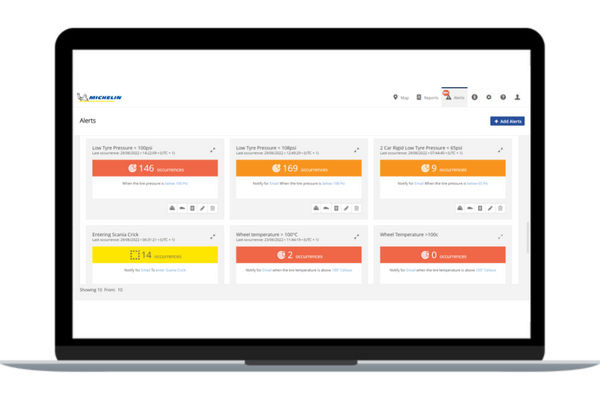
Brake performance alerts, to keep on top of maintenance work.
![]()
Brake performance reports, to automate compliance requirements.
![]()
Rollover alerts, to help identify hazardous routes or driving behaviours.
![]()
Harsh braking alerts, to monitor driving behaviour.
If you run trailers and you are weighing EBPMS against four laden roller brake tests a year, we can walk you through what that looks like for your operation. We work with fleets across transport and logistics, and brake monitoring sits alongside vehicle tracking, vehicle checks, and productivity in the same platform. Talk to an expert.
+
Electronic Braking Performance Monitoring System. You will also see it written as Electronic Brake Performance Monitoring System; the DVSA specification uses "Braking", while "brake" is the more common usage in the industry. They refer to the same thing.
+
The EBS is the braking system itself: it controls how the trailer brakes. The EBPMS is a monitoring layer that reads the data the EBS produces and assesses performance over time. Without an EBS there is no data to read, and without an EBPMS there is no assessment. A trailer needs an EBS fitted before an EBPMS can work.
+
Not entirely. Validated EBPMS data satisfies the brake performance assessment at routine safety inspections, which is where most of the testing burden sits. The annual test still requires a physical roller brake test. So the practical effect is fewer laden tests through the year, not none.
+
The DVSA provision applies to trailers. There is no equivalent arrangement that allows EBPMS data to substitute for brake testing on motor vehicles, so a rigid or a tractor unit still needs its laden roller brake tests.
+
Brake demand pressure, axle load, vehicle speed and deceleration, road gradient, and timestamps, captured around each braking event. From those it calculates a braking performance figure and tracks how it changes over time.
+
It depends on fleet size, how many trailers you fit, and whether the system runs alongside other telematics on the same platform. The comparison worth making is not the price on its own but the cost it displaces: loading a trailer and running it over a roller tester several times a year carries a cost in testing fees and in downtime.
Schedule a demo and find out how MICHELIN Connected Fleet can help your business or speak to an expert who will answer any questions you have .
Sales: +44 113 281 4899
Customer Support: +44 113 281 4842
Lynton House
7-12 Tavistock Square
London
WC1H 9LT
Privacy Policy | Cookie Notice | Legal Notice | Legal Information
©2026