What fleet tracking software does

Fleet tracking software collects location and vehicle data from every vehicle in your fleet and presents it in one place, in real time. Where a basic tracker answers the question "where is it", tracking software answers the ones that follow: where has it been, how long did it stop, who was driving, was that route the one we planned, and what should we do about it.

In practice that means four things running at once.

  • A live view. Every vehicle on one map or in a sortable table, updating continuously, with the ability to filter by group, region, or vehicle type.

  • A record. Historical journeys, stops, and idle time, retained so you can answer a customer query or a compliance question weeks later.

  • Rules and alerts. Geofences, route corridors, and thresholds you set once, which then tell you when something happens rather than waiting for you to look.

  • Reporting. Utilisation, mileage, idling, and driver activity, produced on a schedule rather than assembled by hand each month.

Tracking is one part of a wider platform. For everything that sits around it, see our fleet management software.

OEM_LCV

THE NEEDS: 

  • Tracking your fleet whereabouts 
  • Adapting quickly to new devel­op­ments 
  • Making informed decisions about your fleet and drivers

THE BENEFITS of Fleet Management Tracking:

Fleet management tracking is the point where location data stops being a map and starts being management information. Three things change once it is in place.

  • You always know where vehicles are, in real time. Which matters most when something has gone wrong: a delayed delivery, a missed window, a vehicle somewhere it should not be.
  • Customer conversations get easier. Precise location information means an accurate answer rather than an estimate, and fewer calls asking where the driver is.
  • Savings become visible. Comparing previous trips shows where mileage, idling, and routing are costing more than they should. See reduce fleet costs for what that looks like across a fleet.

Fleet tracking solutions of this kind are usually bought for one of those three reasons and then kept for the other two. If you are weighing up which matters most to your operation, our guide to fleet management sets out how tracking fits alongside everything else.
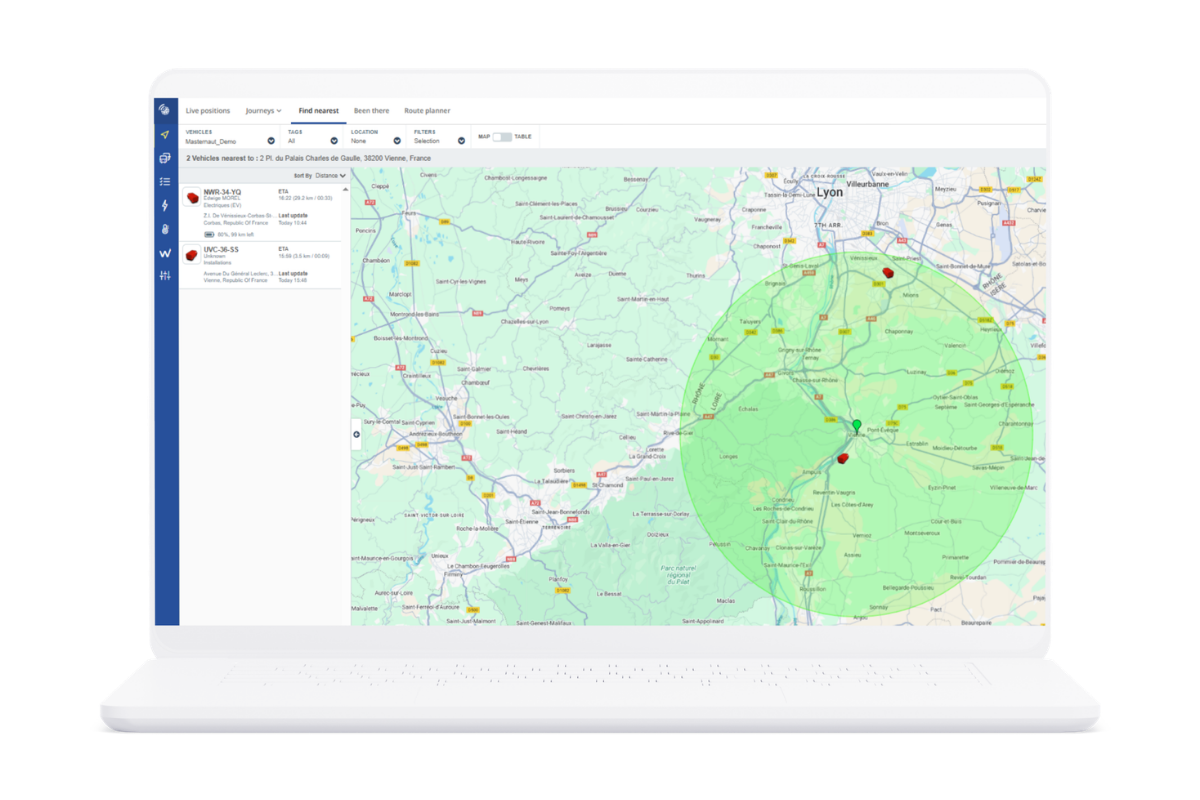
What our fleet monitoring system does:

geolocation-tn-3

1

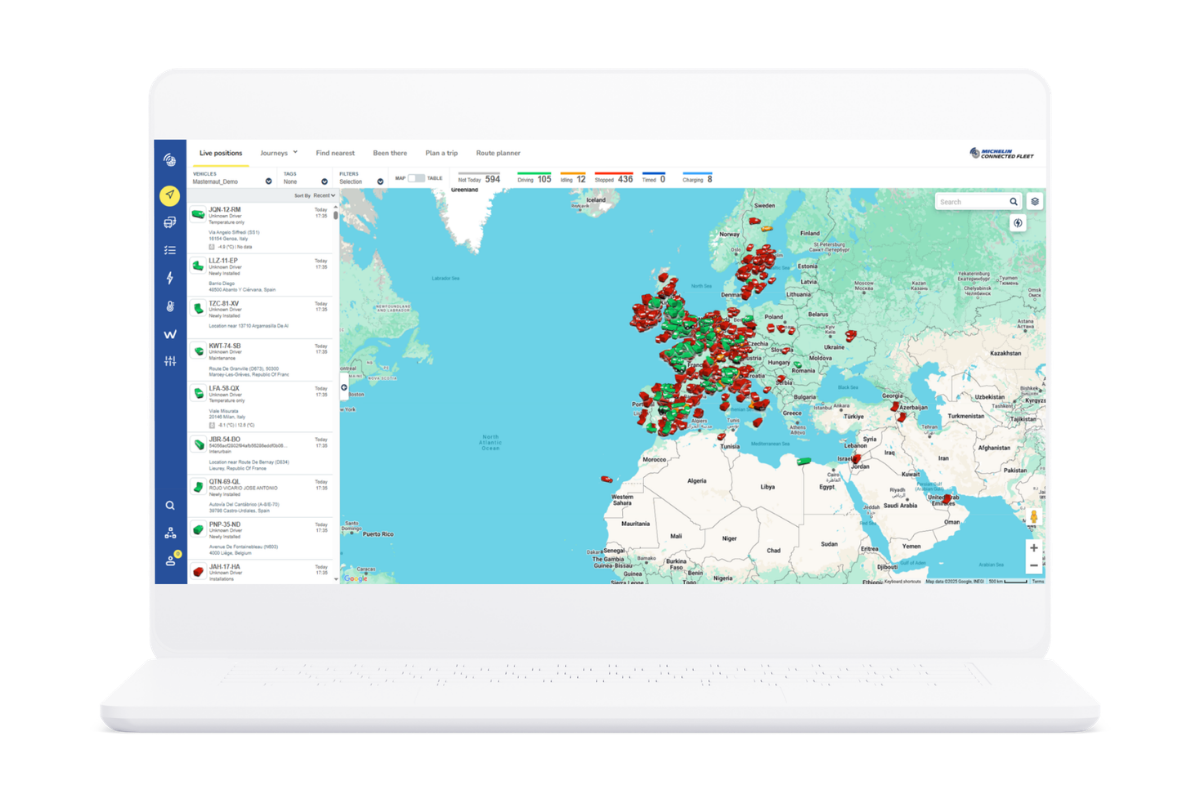
See vehicle and driver location on the map. Pages NEEDS (600 × 400px) (4) Pages NEEDS (600 × 400px) (5)

2

Flip between map and tabular real time views. Pages NEEDS (600 × 400px) (5)

1 (2)

Route corridors: set a route and get an alert when a driver deviates from it. Pages NEEDS (600 × 400px) (4) Pages NEEDS (600 × 400px) (5)

4

Find the nearest vehicle, plan route directions and email to drivers. Feeds directly into job management. Pages NEEDS (600 × 400px) (5)

5

Activity visibility, with idling and stop hours per driver. Pages NEEDS (600 × 400px) (5)
geolocation-tn2-3

6

Create routes, and overlay routes and points of interest on the map. Pages NEEDS (600 × 400px) (5)

7

Tachograph hours: set up infringement alerts and get real-time and historical visibility of tachograph hours, activities, and infringements. See driver hours management. Pages NEEDS (600 × 400px) (4) Pages NEEDS (600 × 400px) (5)

8

View real-time fuel levels per vehicle. Pages NEEDS (600 × 400px) (4) Pages NEEDS (600 × 400px) (5)

9

Geofencing: set up zones and alerts for entry to and exit from predefined geographical boundaries. Pages NEEDS (600 × 400px) (4) Pages NEEDS (600 × 400px) (5)

1 (2)-1

Filter by group, activity, EV state, and custom tags, and view up to 10,000 vehicles on one screen. Pages NEEDS (600 × 400px) (5)

What it costs, and what it runs on

Fleet tracking software is normally sold as a subscription per vehicle per month, with the tracking hardware either included or purchased separately depending on the arrangement. What moves the price is fleet size, the type of hardware each vehicle needs, and which capabilities you switch on beyond location.

What is worth establishing before comparing quotes:

  • Whether hardware is included, leased, or bought, and who owns it at the end of the term.
  • Whether installation is included, and whether vehicles need to come off the road for it.
  • What the contract term is, and what happens to your historical data if you leave.
  • Whether support and analysis are included or charged separately.

Our platform runs in a browser with no local installation, works across mixed fleets including electric vehicles, and integrates with the business systems you already run. Pricing is quoted against your fleet rather than from a list, because a hundred vans and twenty HGVs on international work are not the same problem.

Why choose us for UK fleet tracking

Our vehicle tracking gives you full fleet visibility, whether you manage a small business fleet or a large operation. Through GPS, each vehicle’s location is accurately tracked in real time and transmitted to our central system. From there, you get instant access via an intuitive, cloud-based platform, where you can view live maps alongside actionable historical data.

Tailored geofences let you monitor key locations and stay informed about critical vehicle activity, while built-in insights into driver behaviour and comprehensive reporting help you make smarter decisions. You will be better equipped to improve safety and efficiency, driving stronger cost control, better service delivery, and smoother operations. We work with fleets across transport and logistics and field services, and you can see the results in our customer stories.

Fleet Tracking FAQs

What is fleet tracking and how does it work?

+

Fleet tracking uses GPS to monitor vehicles and drivers in real time. Information such as location, speed, and route details is transmitted to a secure, cloud-based system. This data is then displayed on a centralised dashboard, allowing managers to view live activity, review performance, and produce detailed reports.

What are the benefits of GPS fleet tracking?

+

GPS fleet tracking offers a lot more than basic location updates. It improves overall efficiency by highlighting driving patterns that affect fuel consumption, safety, and operating costs. Continuous visibility also lowers the chance and impact of vehicle theft. In addition, accurate tracking makes it easier to provide reliable ETAs to customers while ensuring compliance with driver hours regulations.

Is fleet vehicle tracking legal?

+

Yes, fleet tracking is legal, provided it is carried out responsibly. Businesses must comply with the Data Protection Act and GDPR, which means being transparent with drivers about how, when, and why tracking takes place. When introduced correctly, employees will understand that tracking is intended to increase safety, security, and efficiency, rather than reduce privacy.

What is the difference between vehicle tracking and telematics?

+

GPS fleet tracking systems simply locate vehicles in real time, while telematics combines location data with details such as fuel usage, vehicle condition, and driver behaviour. At MICHELIN Connected Fleet, our GPS fleet management system integrates telematics to offer more comprehensive performance insights.

What is fleet tracking software?

+

 Fleet tracking software allows operators to monitor and manage all their vehicles from a single platform by providing a complete overview of a fleet, whether looking at overall performance or an individual vehicle. It also supports wider fleet management tasks such as scheduling maintenance, improving efficiency, and ensuring vehicles are operating as they should. 

How does fleet tracking software work?

+

Fleet tracking software uses GPS to collect data on vehicle location, movement, and usage before transmitting it to a secure platform, where it is processed and presented in a dashboard. Because the system updates in real time, managers can monitor their fleet continuously and so gain insights into driver behaviour and route efficiency at any time.

How much do vehicle tracking systems cost?

+

The cost depends on the size of your fleet, the type of hardware required, and the features included in the package. We offer flexible subscriptions, allowing managers to scale the service as a business grows, and the system generally pays for itself through reduced fuel consumption, improved route planning, and lower maintenance costs. Before comparing quotes, it is worth checking whether hardware, installation, and support are included, what the contract term is, and what happens to your historical data at the end of it.

What is the difference between a fleet tracker and fleet tracking software?

+

A fleet tracker is the hardware in the vehicle: the device that captures location and sends it on. Fleet tracking software is the platform that receives it, stores it, applies your rules, and turns it into something you can act on. You need both, and the difference between suppliers is usually in the software rather than the device.

Can fleet tracking software integrate with our existing systems?

+

Yes. Tracking data is most useful when it reaches the systems your business already runs, so integration with ERP, scheduling, and back-office software is standard rather than exceptional. Where no ready connector exists, APIs are available. It is worth asking any supplier which of your specific systems they have connected before, and whether maintenance and incident data flows through the same platform or sits separately.

How many vehicles can the system handle?

+

Up to 10,000 on a single screen, filtered by group, region, activity, or custom tag. In practice the constraint at scale is rarely the number of vehicles but whether permissions and reporting can be structured to match how the business is organised, so that a regional manager sees their own fleet rather than the national list. Our fleet management glossary covers the terminology if any of this is unfamiliar.